Last updated November 17, 2026








Free written scope consultation - allowances, timeline, and change-order rules on paper before a single trade is scheduled
DIY vs Professional Construction: The Sunrise Manor Homeowner’s Decision Guide
Painting a bedroom is DIY. Replacing a bathroom exhaust fan is probably DIY. Relocating that fan six inches to clear a joist, a change that looks like an afternoon’s work, crosses into permitted electrical work in Clark County. Do it without the permit and the moisture damage that follows months later can land on your homeowner’s insurance as an uncovered claim. That gap between “looks simple” and “legally and financially complicated” is where most Sunrise Manor projects get into trouble. This guide draws the line in the places that actually matter: permits, liability, and the desert conditions that break work done by the tutorial method.
Quick Answer
In Sunrise Manor, the DIY-versus-hire decision isn’t really about skill. Cosmetic work (painting, tiling a backsplash on sound substrate, swapping a faucet) is genuinely DIY-safe. Work that touches permits, plumbing or electrical systems, structural elements, or anything with a written warranty attached usually belongs with a licensed contractor, because Clark County permit rules, insurance exposure, and desert-specific failure modes make a do-over far more expensive than hiring it right the first time.
Styles & brands we work with
- Kitchen remodeling
- Bathroom remodeling
- Home additions & ADU
- Roofing
- Windows & doors
- Driveway & pavers
- Fence
Table of Contents
- The Project-by-Project Decision Matrix
- What Clark County Lets You Do as an Owner-Builder
- Desert-Specific DIY Risks Nobody Warns You About
- The Real Cost of a Failed DIY in Sunrise Manor
- How Inspections Interact With Work You Did Yourself
- Five Questions to Ask Before You Pick Up a Tool
- What a Written Guarantee Actually Covers
- Common Mistakes to Avoid
The Project-by-Project Decision Matrix
Most guides hand you a vague “hire for big jobs, DIY the small ones.” That’s not useful when the job that voids your insurance looks small. Here’s how we’d sort the common Sunrise Manor remodeling tasks, based on permit triggers and warranty implications rather than square footage.
Genuinely DIY-safe (no permit, low liability):
- Interior painting and trim work on sound surfaces
- Swapping a kitchen faucet or showerhead on existing supply lines
- Replacing cabinet hardware, hanging shelves, installing a new toilet in the same location
- Laying peel-and-stick or floating floor over a prepared, level subfloor
- Caulking and re-grouting interior tile joints (with the caveat below about exterior work)
Requires a licensed trade or a permit (not DIY):
- Any electrical work beyond swapping a fixture on an existing circuit: moving an outlet, adding a circuit, relocating a fan or light
- Relocating or replacing plumbing supply or drain lines, including moving a sink or adding a shower
- Removing or altering a load-bearing wall
- Bathroom and kitchen remodels that change the footprint or add fixtures, which trigger permit and inspection requirements in Clark County
- Anything involving gas lines, water heaters, or panel work
The line isn’t about how hard the task feels. It’s about whether the work is inspected, insured, and guaranteed. If a contractor installs a $14,000 kitchen using KraftMaid cabinetry and Cambria quartz, the work is covered in writing. If a homeowner installs it and a cabinet falls off the wall in year two, nobody covers it. For a broader look at how the full scope comes together, our general contractor in Sunrise Manor page walks through the permit-and-inspection side of larger projects.
What Clark County Lets You Do as an Owner-Builder
Nevada gives homeowners real latitude to work on their own primary residence as an “owner-builder.” You can pull certain permits in your own name, do the work yourself, and have it inspected. What you can’t do is hire unlicensed people to do permitted work on your behalf and call it owner-builder.
The practical result for a Sunrise Manor homeowner:
- You can legally pull a permit for work on your own home and perform it yourself, subject to inspection by Clark County.
- You still have to pass the same inspections a licensed contractor would. Rough framing, electrical rough-in, and final inspections apply to you too.
- Owner-builder work typically isn’t covered by a contractor’s warranty, because there’s no contractor. If it fails, the cost is yours.
- Selling within a defined window can require a disclosure of owner-builder work, and buyer financing (FHA and VA in particular) can flag unpermitted additions.
Where people get into trouble is the gray zone: swapping a bathroom exhaust fan without a permit is common and often overlooked, but moving that fan means cutting into the ceiling structure and running new electrical, which is permitted electrical work. That’s the kind of small change we see at the start of a lot of bathroom projects in Sunrise Manor, and almost always it’s less expensive to permit it correctly the first time than to explain it to an inspector or an insurance adjuster later.
Desert-Specific DIY Risks Nobody Warns You About
Most of the remodeling tutorials on the internet were filmed in mild, humid climates. Sunrise Manor runs the other direction: triple-digit summers, single-digit humidity, and a hard freeze or two most winters. That changes how three common materials behave.
Summer tile work
Thinset and grout cure by drying, and in 110-degree heat with no humidity they dry too fast. Tile set on a warm afternoon in July can lose bond before the thinset cures, and it fails months later as hollow-sounding, cracked tiles. A contractor working in Sunrise Manor knows to work in cooler hours, keep the substrate damp, and use a modified thinset rated for the conditions. This is a job where the timing and the substrate prep behind the tile (the moisture-resistant cement board substrate, i.e. the layer behind the tile) matter as much as the tile itself.
Exterior caulking and paint
Synthetic sealants cure differently at 8% humidity than the humid-climate tutorials assume. Caulk applied over a hot exterior wall can skin over before it bonds, and it peels the first season. Exterior stucco and wood trim also expand and contract across the desert temperature swing, so the wrong sealant fails at the joint. We install James Hardie siding and trim for exactly this reason: it’s rated for the swing, and it carries its own manufacturer warranty.
Drywall finishing
Mud applied thin in a dry climate can flash-dry and crack at the seams. Finishers working in Sunrise Manor account for the ambient conditions, and the difference shows up a year later when a hairline crack appears along a seam in a room you’re about to repaint. Drywall hanging itself is approachable for a confident DIYer; the finishing is where the climate bites.
One more: concrete work. Bagged mixes from Quikrete and Sakrete are standard, but pouring a slab in summer without accounting for evaporation means a slab that cures weak and cracks. For anything structural, it’s not a first-time DIY job.
The Real Cost of a Failed DIY in Sunrise Manor
The number people forget isn’t the cost of the original attempt. It’s the cost of undoing it. A contractor hired to fix failed DIY work has to remove the old work, repair any damage underneath, then redo it, which is reliably more expensive than doing it right from the start.
Common scenarios we’ve seen in Sunrise Manor:
- A shower that leaks two years in. DIY tile with no correct waterproofing means a failed pan, water behind the wall, and a full tear-out that includes replacing the substrate, tile, and any rot in the framing. Far more than a properly installed shower would have been.
- A relocated exhaust fan with a moisture problem. Unpermitted electrical plus a vent run that terminates in the attic instead of outside pushes warm, moist bathroom air into the attic. A few winters later, there’s moisture damage to the ceiling and drywall a contractor has to remediate.
- A cabinet install that pulls off the wall. Cabinets hung on the wrong fasteners or missing wall blocking fail under load. The cost is the cabinet, the wall repair, and re-hanging by someone who knows to hit the studs and blocking every time.
- A flooring job on an unlevel floor. Floating or laminate flooring laid over a floor that was never leveled telegraphs every dip, cups at the seams, and lifts. The fix is a full removal and redo with a moisture and level check first.
For a bathroom specifically, the sticker shock of a proper install is real, and it’s worth understanding where the money goes in our bathroom remodeling in Sunrise Manor guide before comparing it to a DIY budget that ignores waterproofing and permit costs.
How Inspections Interact With Work You Did Yourself
If you pull an owner-builder permit, you are subject to the same Clark County inspection schedule a contractor is. What inspectors check on a bathroom or kitchen remodel, in practical terms:
- Rough framing inspection before any wall is closed in.
- Electrical rough-in showing proper wiring, box placement, and GFCI protection in wet areas.
- Plumbing rough-in with the correct drain slope and water lines tested under pressure.
- Insulation and vapor barrier installed correctly for the climate.
- Final inspection after finishes, confirming the work matches the permitted scope.
The friction point is that a failed inspection means rework before you can move on, and there’s no guarantee a DIYer will catch in advance what an inspector flags. A contractor pulls the permit, schedules the inspections as the work progresses, and is on the hook to correct anything the inspector rejects. That’s the part you’re paying for when you hire, and it’s why permit-pulled, inspected work is a selling point on a home rather than a strike against it.
Five Questions to Ask Before You Pick Up a Tool
“Can I do this?” is usually the wrong question. The one that saves people money is “what happens if I get it wrong?” Work through these before you start:
- Does this require a permit in Clark County? If yes, decide whether you’re willing to pull it as an owner-builder and schedule the inspections yourself.
- What’s the cost of the do-over? If removing and redoing the work costs more than hiring it, and the failure rate isn’t near zero, that’s your answer.
- Does the work carry a warranty? Contractor-installed cabinetry, countertops, and fixtures carry manufacturer warranties (Cambria quartz, for instance, carries a lifetime warranty) plus the contractor’s own guarantee. DIY-work warranties are zero.
- Who’s at the receiving end of a failure? Water damage, an electrical fault, or a failed structural change can affect insurance coverage and resale. Ask whether you can absorb that.
- Are you comfortable with the safety-relevant parts? Electrical panel work, gas lines, and anything involving structural loads aren’t fail-safe; when they go wrong, the consequences are serious. Those are jobs for a licensed trade every time.
If the honest answer to three of those five is “I hadn’t thought about it,” that’s the cue to get a written quote before you start. A kitchen remodeling in Sunrise Manor project, for example, touches plumbing, electrical, cabinetry, countertops, and permits at once, which is a lot of moving parts to hold yourself.
What a Written Guarantee Actually Covers
Here’s the reasoning to carry into any project, whether it’s a repair or a full remodel: the promise matters more than the price on the first day. A written guarantee should say what’s covered, how long it lasts, and what happens if it fails.
At Penhallow, every project comes with a written price before any work starts and the 365-Day Done Right Promise: if the work fails inside that period, we come back and make it right at no charge, and a failed repair gets a free return visit with no service-call fee. The 365-Day Done Right Promise is included in writing on every job, which is the whole reason it’s worth naming when you’re weighing DIY against hiring. There’s also a written guarantee on every repair, and the materials we source from recognized brands (KraftMaid and Wellborn cabinetry, Kohler and Moen fixtures, Cambria and Silestone countertops) carry their own manufacturer warranties alongside ours, so there are two layers of protection behind the work instead of none.
The comparison to DIY is stark: a DIY faucet installed wrong leaks, and the warranty on the faucet may not cover damage to the cabinet below it, and nobody covers your labor. A contractor installs it under a written guarantee, a defined arrival window, and a clean job site under The Kingswell Way (say the price before the work, show up in the window, leave the place cleaner than we found it). That standard is the reason people hire the work out.
Common Mistakes to Avoid
- Doing permitted electrical work without a permit. Moving an outlet, a fan, or a circuit yourself to save a few hundred dollars is the fastest way to void insurance coverage if something fails. Get the permit or use a licensed electrician.
- Choosing tile adhesive and grout without reading the climate label. The bag that worked in a Maine bathroom can fail in a Sunrise Manor summer. Match the product to the temperature and humidity range.
- Treating a verbal quote as a price. Homeowners who get burned by contractors usually accepted a verbal estimate and never got it in writing. Get a written number, the scope, and the payment schedule before work starts.
- Skipping the water test on a DIY shower pan. A pan that holds water for the first week can seep for months. A contractor tests the pan before setting tile. If you’re going DIY, don’t skip the flood test.
- Painting over exterior caulk applied in full sun. It skins and fails before it bonds. Work in shade or on a cooler day, and re-caulk rather than paint over a suspect joint.
- Hiring the cheapest bid without checking for permits and insurance. A contractor who offers to “skip the permit” for a Sunrise Manor bathroom remodel is passing the risk to you. Confirm they pull permits and carry insurance.
- Assuming a failed DIY is a cheap fix. Undoing and redoing almost always costs more than doing it right. Price the do-over before you start, and if the math is close, hire it.
See the difference
 Before
 After
 Before
 After
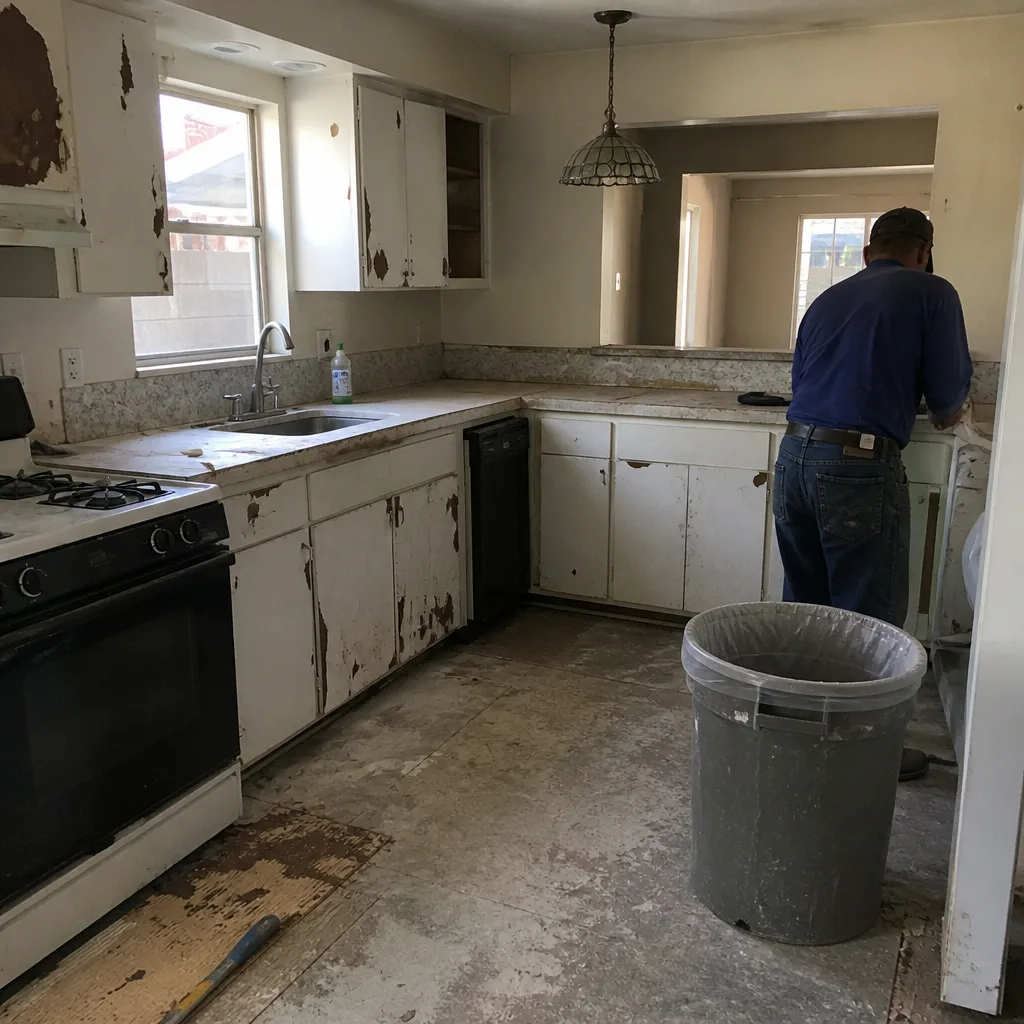 Before
 After
When to Call a Professional
The clearest cue to call a contractor is a job with two or more of the following: it needs a permit, it affects water or power, it changes structure, or it fails in a way that damages the rest of the house. A bathroom remodel in Sunrise Manor almost always ticks at least two of those. Kitchen work ticks three or four. And even some “small” tasks (relocating an exhaust fan, moving a sink a few inches, adding a dedicated circuit) fall on the call-professional side because of what’s behind the wall. If you’re not sure which category a job falls into, describe it to us and we’ll tell you plainly whether it’s a DIY job or a contractor job. Penhallow Remodeling Sunrise Manor offers free estimates in Sunrise Manor and written quotes before any work starts; call (844) 972-4834 to talk through your project.
Frequently Asked Questions
Yes, for purely cosmetic work with no permit requirement, and for permitted work you pull yourself as an owner-builder on your primary residence. Anything touching electrical, plumbing, gas, or structural elements is where DIY stops being sensible, because insurance and resale implications usually outweigh the savings.
Often not, or only partially. Many policies require that work affecting the building’s systems be permitted and inspected. Unpermitted electrical or plumbing work that causes damage can lead to a denied claim, so it’s worth asking your insurer before you start any job in Sunrise Manor that touches those systems.
It covers the labor and the fix. If the work fails within the guarantee period, the contractor returns and makes it right at no charge, which is written into every Penhallow project. DIY work has no such backstop; a failed repair or install is a cost you absorb.
Heat and low humidity cause thinset and grout to dry too fast, which keeps the tile from bonding properly. It’s a climate issue, not a product defect, and a contractor sets tile with the right thinset, substrate preparation, and working conditions for the desert. Call (844) 972-4834 for a free estimate if you’re weighing a DIY tile job against hiring it.
A straight swap on an existing circuit in the same location is usually fine without one. Moving the fan, adding a new cut in the ceiling, or running new wire crosses into permitted electrical work. When in doubt, pull the permit or call a licensed electrician.
It varies by project, but the honest version is that a contractor adds labor, permits, and a written guarantee to the material cost you’d pay anyway; a kitchen remodel typically runs well into five figures once you account for cabinets, countertops, and installation. The gap is usually far less than the cost of a single failed DIY redo, which is the comparison worth making. Call (844) 972-4834 for a written quote on your project.
The Bottom Line

The DIY-versus-hire line in Sunrise Manor isn’t drawn by skill. It’s drawn by permits, liability, and the desert conditions that break work done the tutorial way. Cosmetic work is genuinely DIY-safe. Anything that needs a permit, touches water or power, changes structure, or risks a failure with real damage belongs with a licensed contractor who pulls the permit, passes inspection, and stands behind the work in writing. Run the do-over cost before you start; if the math is close, hire it. And if the work is going to be done by someone else, make sure the price and the guarantee are on paper. For a fuller picture of what we do, start at our Penhallow Remodeling Sunrise Manor home page.
Call (844) 972-4834 for a free estimate on your Sunrise Manor project. We’ll give you a written price before any work starts, a defined arrival window, and a written guarantee on every job, so the number you see on day one is the number on the invoice.
Written by the team at Penhallow Remodeling Sunrise Manor.